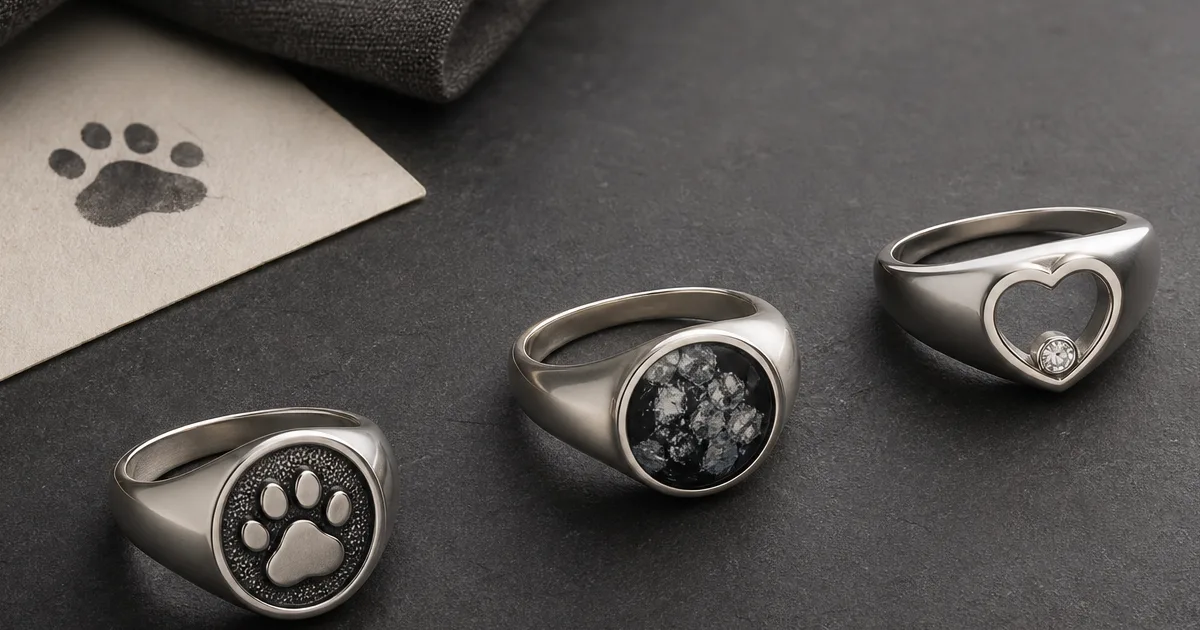
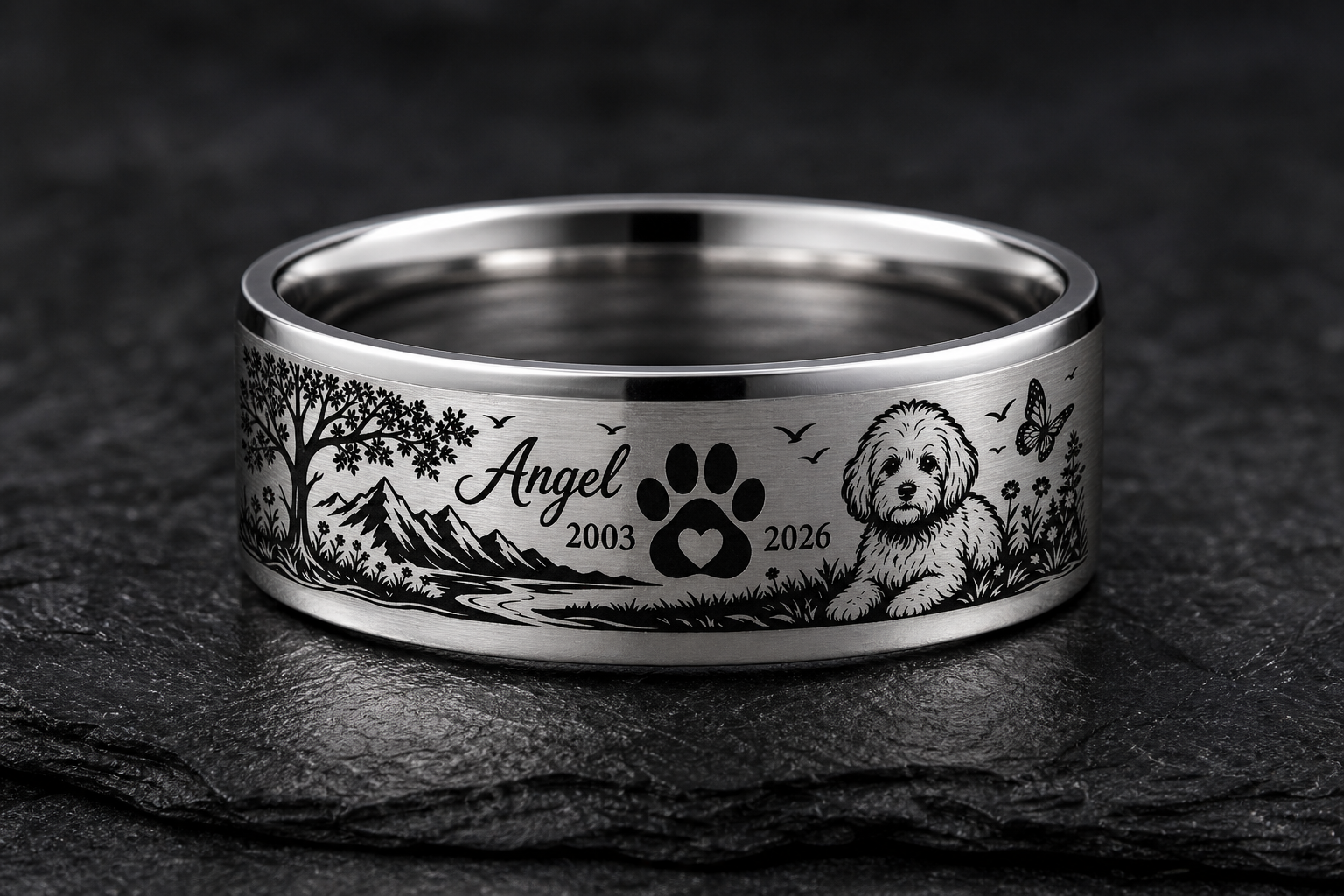
Multi-dog households face a specific design problem: the grief is real for each dog, but a single ring can only do so much. The solution is not to crowd everything onto one band but to decide clearly which approach the loss calls for.
If the dogs died at different times and each loss deserves its own ring, a stacking band approach is usually the most meaningful. Each thin band carries one dog: the name, the years, and one mark. The stack grows over time and each band stays readable on its own.
If both dogs were inseparable in life — litter mates, bonded rescues, lifelong companions — they may belong on the same ring. In that case, use the outside for one dog's mark and the inside for the other's, or carry both names on the outside with a dividing element like a small paw or date separating them.
The clearest two-dog outside layout is one paw print per dog, spaced evenly around the band, each with a small name below it. It reads as intentional rather than crowded and works at most band widths above five millimeters.
For three or more dogs, the stacking band approach is almost always the right call. A single ring carrying three dogs risks losing all three of them to visual noise. A set of thin bands, worn as a group, is actually more striking to look at than one complicated design.
Names are where most multi-dog rings succeed or fail. Use the dogs' actual names and nicknames — the ones said at the back door and not the formal registered names. Short names engrave more clearly than long ones, and two short names side by side usually work well on the outside of a band.
The source prints matter more in multi-dog designs because the risk of confusion is higher. If both dogs have similar paw sizes or the same breed profile, make sure each source is labeled clearly. A print labeled with the dog's name and approximate date creates a record the designer can use accurately.
Date ranges help distinguish the dogs without extra text. A band that carries "Sadie 2012–2024" outside and "Scout 2015–2026" inside communicates two full stories without requiring any additional explanation from the wearer.
Some owners choose to honor a living dog and a lost one at the same time — one ring that marks the dog they still have and one for the dog that is gone, worn together so the stack acknowledges both. That approach works especially well when the living dog is also aging.
When the decision between one ring and a stack is made, bring the clearest source material for each dog — name, dates, best print or photo, and a note about the relationship between them — into the Friends of Irony designer and build the simplest version that still feels right.