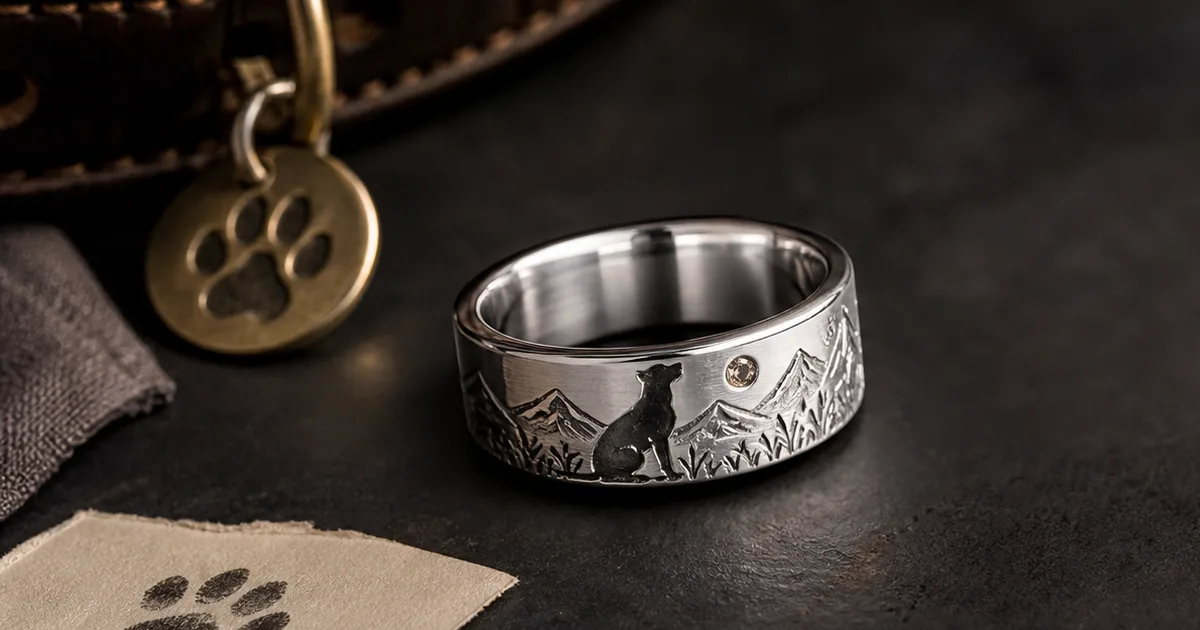
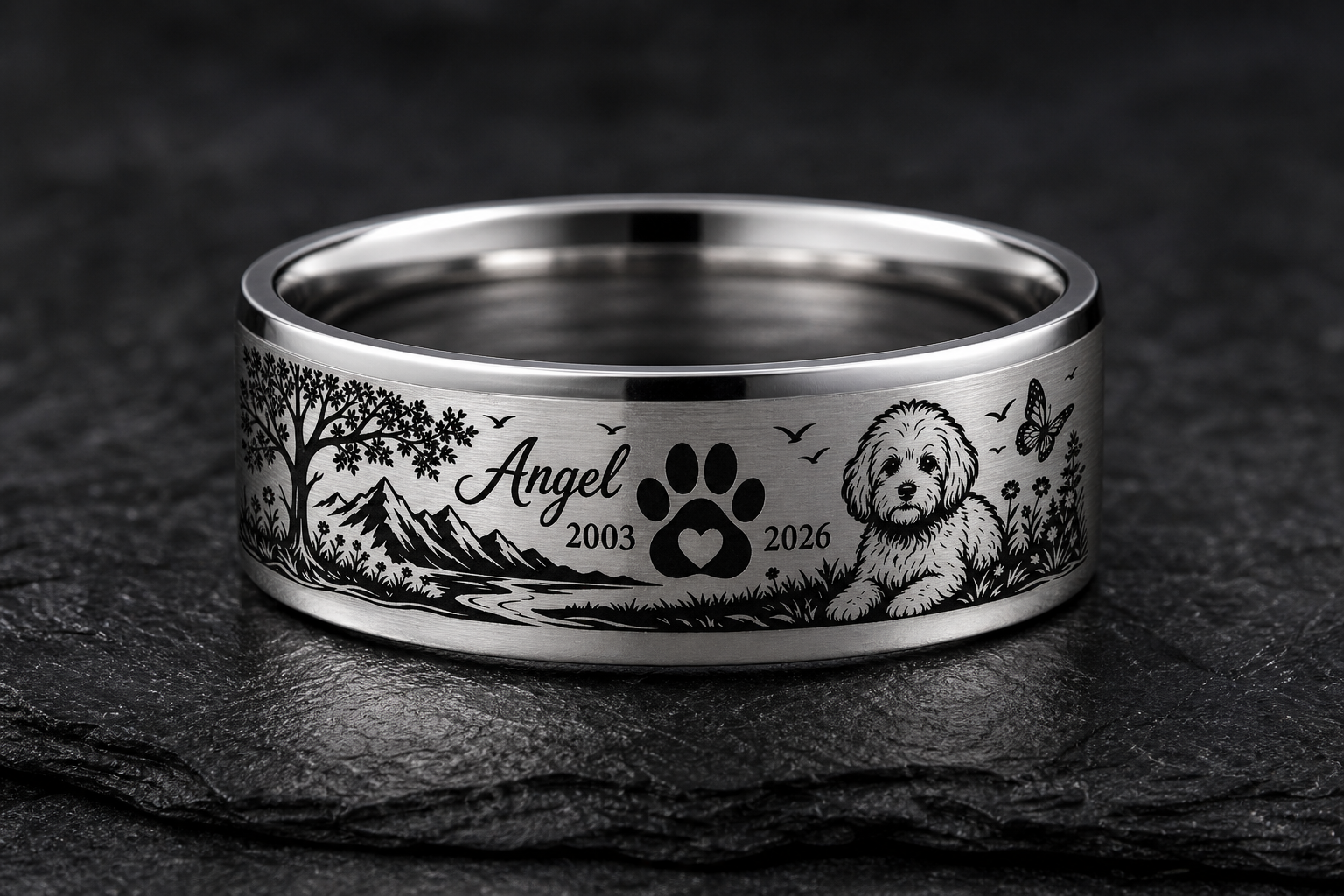
Men who lose a dog often carry that grief without much ceremony. A ring is one of the few quiet, permanent ways to hold it — and the right design is not the same as what memorial jewelry typically offers in the first search results.
Start with what the dog actually meant to the wearer, not with jewelry conventions. Was the dog a running partner, a job companion, a hunting dog, a truck dog, a guard dog, or just the creature that was always there? That character should shape the design before any other decision.
Band material and finish matter more here than in most memorial ring design work. A dark tungsten-style or blackened silver band, a wide brushed finish, or a clean matte surface changes the whole emotional register of the piece. Something that looks too delicate will not be worn every day, which defeats the purpose.
A paw print on the outside is the clearest and most common choice, and it reads well in masculine design contexts when it is clean and slightly simplified rather than overly ornate. A single print, centered or placed as a panel with the dog's name beside it, is usually the most versatile option.
If the dog was a working or sport breed — a Labrador, a German Shepherd, a Vizsla, a Border Collie — the dog's role can shape the design. A hunting dog can have a bird dog outline; a working dog can have a silhouette that captures the stance. Breed-specific shapes read more personally than generic paw prints in those cases.
Wording on a men's dog memorial ring tends to work better when it is short and plain: the dog's name and the years, "Good Boy," "Best Dog," a phrase that actually captures the relationship. Men tend to avoid formal memorial language that sounds like it belongs on someone else's ring.
Inside engraving is a strong option for men who want the meaning private. The outside stays clean and reads as ordinary jewelry; the inside holds the dog's name, dates, or the exact phrase said at the back door every evening. That combination covers the need for permanence without requiring explanation.
Width matters practically. A band that is too narrow feels out of place on a large hand; one that is too wide becomes uncomfortable during physical work. For a men's ring intended for daily wear, choose the width that matches the other rings or wrist hardware the person already wears.
If the man lost more than one dog, a stacking band approach works well: one narrow band per dog, each with a single mark and name, worn together on the same finger. The stack grows with each loss and does not require redesigning the original ring.
When the details are settled — the dog's name, dates, source print or photo, the finish direction, and the phrase that matters — bring them into the Friends of Irony designer with a note about the intended daily wear context.